Here is the way I related the Paterson ice flow power law
formulation for ice rheology to that used by the ADINA-F finite element model
system - with help from Nadine and EdW.
Problem:
Relate the flow law of Paterson
to the “Power Law” material model of ADINA-F.
From Paterson:
(1) eij=B tijm where eij is
meant to mean strain rate not strain – I can’t make the “dot”
m is meant to be what Paterson calls “n”
– generally we use 3
B is meant to be what Paterson calls “A”
– e.g. 4.9x1025 s-1 pa-3
From ADINA: (eqn
2.1-5 in tmg-tf)
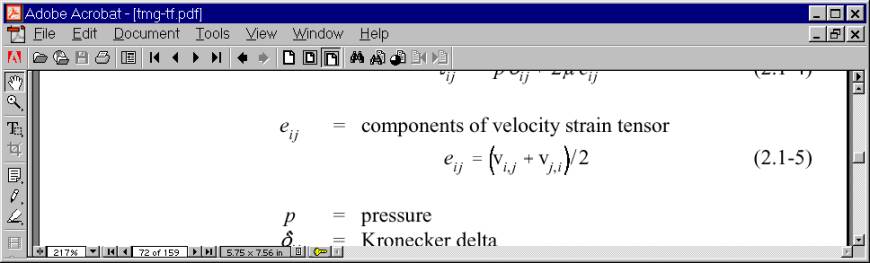
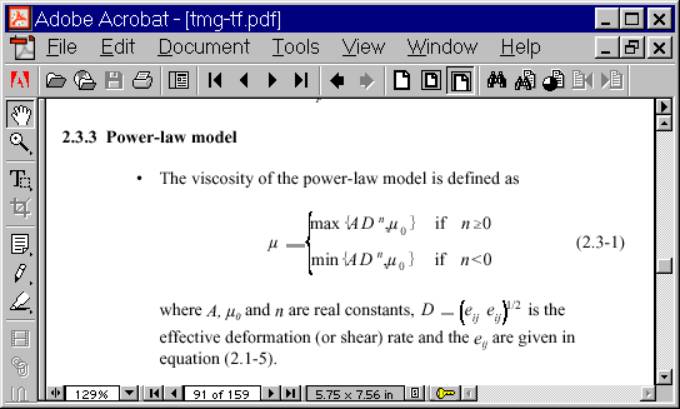
(2) tij=2 m eij where eij is
strain rate and m is viscosity. The power law relationship between stress
and strain rate is expressed through the dependence of m on strain rate.
From ADINA:
(3)
m = A eijn
For the ADINA FEM, we must specify A, n and a mo value
to be used depending on whether n>=0 or n<0.
In the former case mo is used
if it is greater and mo is
used if it is less than A eijn
So, first we find an expression for m in terms of Paterson's “m” and
“B” and then write the FEM parameters A & n in terms of those “m” and “B”.
Starting with Paterson’s (1)
(4) eij=B tijm
Then substitute
from (2) for tij into
(4)
(5) eij=B(2 m eij)n
Solve for m
B-1/m/2 eij(1/m-1)= m
And from ADINA (3)
m= A eijn
We find that in terms of Paterson's "B" and
"m", the FEM values for "A" and "n" are:
A= (B-1/m)/2
and
n=(1/m -
1)
From Paterson we assume m=3 which implies that the FEM
value n:
n=-2/3
From Paterson, "B" for -10C ice = 4.9x1025
s-1 pa-3
A=6.34x10⁷
s1/3 pa
Not sure what to use for a mo
In the model then, we specify the following for now -
neglecting the heat stuff. Note that
the 2-D problems are done in the Y-Z plane with Z positive upward so we specify
-9.8m/s/s acceleration due to gravity.
This will be the only "loading" prescribed in the model -
though it is not considered "loading"
Here are some comments from Ed that got me on back on
track for describing what to use for mo
FROM EDW:
Hi Tony -
This sounds like the right direction to go to convert Glen
into Adina. I think we need to be
careful to use the invariants like "D" in the second box in the
derivation.
Otherwise you may get a
result applicable only to a case where there is only one nonzero stress
component, like simple shear.
The equation (3) from
ADINA says
mu = A eps_{ij}^n
but eps_{ij}^n is a tensor
and mu is a scalar, so (3) should more properly
be
mu = A D^n
like (2.3.1). And
Paterson's Glen law should be
eps_{ij} = B S^{m-1} tau_{ij}
where S^2 = tau_{ij}
tau_{ij} is a scalar, and the invariants are related
by
D = B S^m
eps_{ij} = B S^{m-1} tau_{ij} from Glen
= B S^{m-1} ( 2 mu eps_{ij} ) using (2)
so
B S^{m-1} 2 mu = 1
and
mu = (1/2B) S^(1-m)
= A D^n from ADINA definition
= A ( B S^m )^n
= A B^n S^{nm} from Glen law
Equating coefficients and
powers on left and right
(1/2B) = A B^n
and nm = 1-m
A = (1/2) B^-(n+1) n = 1/m - 1
And using the result for
n,
A = (1/2)
B^(1/m)
TGADES NOTE: slight error on this step exponent
of B should be negative 1/m
so my answer is the same
as yours after all.
The goal of the ADINA
formulation appears to be to prevent the
viscosity from going to
infinity as stress goes to zero when m>1
or going to zero when
m<1.
So mu_0 should be the
viscosity at the "crossover stress" S_0 at which Glen's law goes
linear. Based on ice cube squashing
tests, this stress must be below 0.3 bar, and probably around 0.1 bar, based on
Dave's thesis (tests for Taylor Dome flow model), the poster about the Siple
Dome vertical strain experiment outside ATG 717, and some models for Siple Dome
that Erin has done.
mu_0 = (1/2B) S_0^(1-m)
Charlie's model currently
has both a linear and cubic term in it all the
time, rather than an
abrupt transition like ADINA apparently has.A
It will be a very
interesting test whether you can actually build your own viscosity function to
replace the ADINA power law, because that is what we will need to do to include
anisotropy and other rheological variants.
cheers,
Ed
Ed Waddington
Geophysics Program Box
351650
University of Washington
Seattle WA 98195 USA
So now we take
Paterson Table 5.2 for N=3, A values
are in columns 2,3 and convert them to the language of ADINA:
TEMP A (S^-1 kpa^-3)
0.0000000e+000 6.8000000e-024
-2.0000000e+000 2.4000000e-024
-5.0000000e+000 1.6000000e-024
-1.0000000e+001 4.9000000e-025
-1.5000000e+001 2.9000000e-025
-2.0000000e+001 1.7000000e-025
-2.5000000e+001 9.4000000e-026
-3.0000000e+001 5.1000000e-026
-3.5000000e+001 2.7000000e-026
-4.0000000e+001 1.4000000e-026
-4.5000000e+001 7.3000000e-027
-5.0000000e+001 3.6000000e-027
So here are the
values to use for -10C ice (A) and for -25C ice (B):
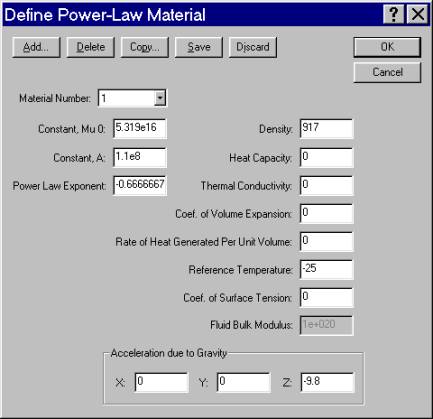
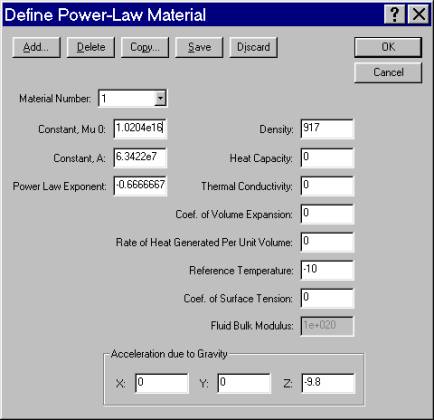
(A) Calculating values
for the FEM.
At -10C (A_paterson = 4.9e-25 s^-1 pa^-3
n_model = 1/n_paterson - 1
= -2/3
A_model = 1/2 A_paterson^(-1/n_paterson)
=1/2 (4.9E-25 s^-1 pa^-3)^(-1/3)
= 6.3422e7
mu_0 = 0.5(1/A_paterson) S_0^(1-m) (assume transition occurs at 0.1bar = 1e4
pascals)
= 1.0204e16
Menu option: MODEL->MATERIALS->POWER LAW->ADD
(B) At -25C (A_paterson =
9.4e-26 s^-1 pa^-3)
n_model =
1/n_paterson - 1
=
-2/3
A_model = 1/2
A_paterson^(-1/n_paterson)
= 1.1e8
mu_0 =
0.5(1/A_paterson) S_0^(1-m) (assume
transition occurs at 0.1bar = 1e4 pascals)
=
5.319e16